
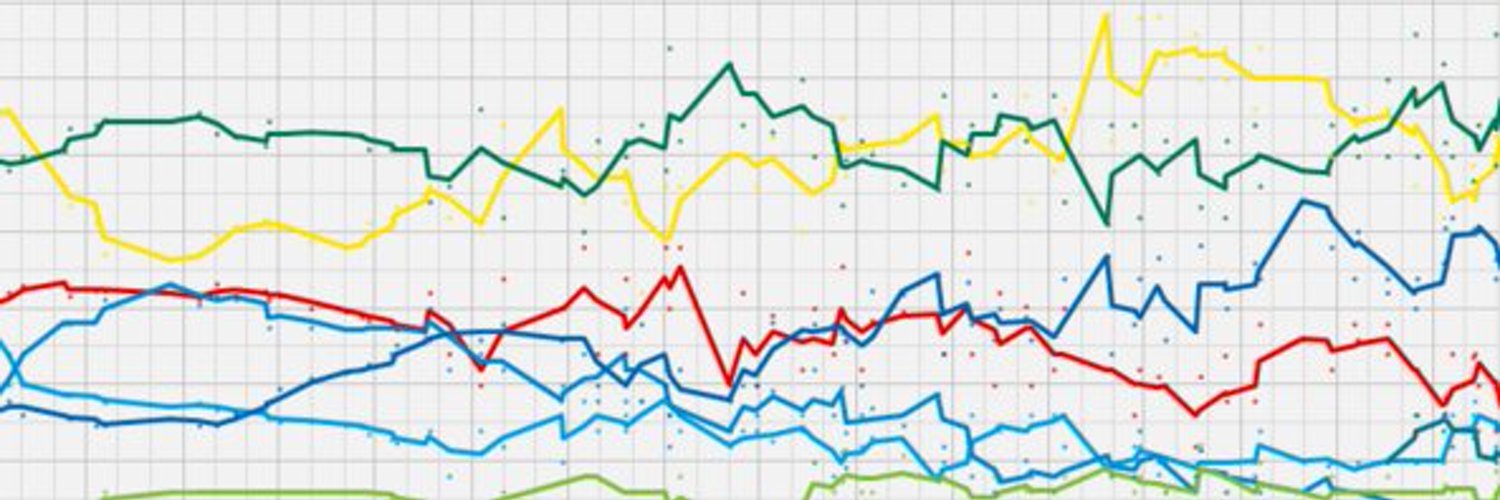
Generic Ballot: Volatility Persists as Democratic Lead Oscillates
The week's generic ballot data reveals persistent methodological sensitivity in national preference measures 20 months before the midterm election. Monday's surveys showed stabilization around a 4-5 point Democratic advantage across three separate firms, suggesting genuine preference rather than noise. By Tuesday, however, a 9-point divergence emerged between Reuters/Ipsos (2-point Democratic lead) and the Wall Street Journal (4-point Democratic lead), illustrating how sample composition and timing can produce substantially different results when measuring the same underlying preference. Wednesday's releases expanded the Democratic margin to 6-8 points via Rasmussen Reports and PPP, marking a reversal from Tuesday's compression.
The week's volatility underscores a fundamental constraint of current polling: surveys conducted this far from an election contain considerable noise and remain unreliable for seat projections. The methodological factors driving variation—registered voter versus likely voter screens, sample size, firm-specific weighting—appear to be producing larger effects than genuine shifts in voter preference. The range of outcomes spanning 2-point to 8-point Democratic margins across the week suggests the true figure likely falls somewhere within that band, but individual surveys offer limited predictive value at this stage. District-level candidate announcements and spending patterns will provide more stable indicators of competitive trajectory than aggregated national preference measures.
North Carolina Senate: TIPP Shows Exceptional Cooper Lead Pending Corroboration
A new TIPP poll released Thursday presents Roy Cooper (D NC-SEN) with a commanding 24-point advantage over Chuck Whatley (R NC-SEN), measuring 48 percent to 24 percent among 1,512 registered voters. The margin substantially exceeds typical general election spreads in competitive Senate races and suggests either extraordinary Democratic strength in the state or methodological factors inflating Cooper's support. The 28-point gap of undecided or other support indicates considerable movement potential before November 2026, particularly given the early stage of the race.
The single-poll release warrants significant caution. TIPP's historical accuracy in Senate races and the absence of corroborating surveys from competing firms prevent confident assessment of whether Cooper holds a genuine decisive advantage or whether the reading represents an outlier driven by sample composition or timing. Expect releases from additional North Carolina Senate pollsters within the coming week; convergence or divergence from the TIPP 24-point margin will establish whether the race is moving toward a decisive Democratic position or remains more competitive than Thursday's survey suggests. Until additional data emerges, treating the TIPP result as a single data point rather than a definitive landscape assessment remains appropriate.
```Polls
```htmlNorth Carolina Senate: Cooper's Substantial Lead
Roy Cooper (D NC-SEN) holds a commanding 24-point advantage over Chuck Whatley (R NC-SEN) in a TIPP poll conducted through January 15, with Cooper at 48 percent and Whatley at 24 percent. The 1,512-sample survey suggests a significant margin, though the undecided portion remains substantial. This represents one of the clearest state-level measurements in recent polling and indicates potential structural challenges for the Republican candidate in the general election.
Generic Ballot: Democrats Lead Across Multiple Surveys
Ten generic ballot polls from the past month show consistent Democratic advantage. PPP (D) reports the widest Democratic lead at 50-42 percent, while Reuters/Ipsos shows the narrowest spread at 40-38 percent. Most surveys cluster between 4 and 6 points, with Rasmussen Reports at 47-41 and Wall Street Journal at 47-43. RMG Research registers the tightest race at 47-46. Sample sizes vary considerably, from 597 to 2,273 respondents, affecting reliability.
The consistency of Democratic leads across different methodologies—from Morning Consult's large 2,201-sample survey to smaller independent polls—suggests the advantage extends beyond single-poll variance, though the magnitude remains contested between pollsters.
```Follow the Money
Ohio Senate: Sherrod Brown's Cash Position
Sherrod Brown (D OH-SEN) reported total receipts of $25.98 million with $17.03 million in cash on hand, the largest war chest among the newly filed reports. His disbursements of $8.95 million suggest a measured spending pace relative to fundraising, leaving him well-positioned in financial terms. The cash-on-hand figure represents approximately 65 percent of total receipts, indicating a candidate preserving resources for the general election phase.
Kentucky Senate: Morris's Depleted Resources
Nate Morris (R KY-SEN) presents a contrasting financial picture. Despite raising $8.59 million, he reported only $708,324 in cash on hand after spending $7.88 million—a burn rate of 92 percent of receipts. His minimal remaining resources relative to total fundraising suggest either heavy investment in early campaign infrastructure or a compressed spending timeline heading into the final stretch of the race.
House Races: Spending Patterns Vary Widely
Mary Peltola (D AK-01) reported $8.66 million raised with $5.73 million remaining, having spent only 34 percent of receipts. This conservative spending approach contrasts sharply with Eileen Laubacher (D CO-03), who raised $8.58 million but has $3.09 million on hand after expending 64 percent of funds. Yevgeny Vindman (D VA-07) and Steve Scalise (R LA-01) show similar mid-range spending discipline, with cash-on-hand ratios of 54 percent and 61 percent respectively, suggesting both campaigns are maintaining resources for anticipated competitive phases ahead.
Headlines
Visit pollingsource.com for the latest political news.
What to Watch
```htmlArizona House Races: Twin Tossups in Competitive Seats
Arizona's 1st District and Arizona's 6th District remain rated as tossups by Cook Political Report, making both seats primary indicators of shifting sentiment in the state's suburban and exurban areas. Monitor early voting patterns and candidate spending allocations in these districts closely, as they often signal broader momentum shifts heading into the general election.
California's Central Valley and Coastal Battlegrounds
CA-13 and CA-22 are rated tossups by Cook Political Report, while CA-45 and CA-47 lean Republican according to Inside Elections and Cook Political Report respectively. These four seats collectively represent competitive territory in both inland agricultural regions and coastal districts, offering insight into Democratic performance in traditionally marginal areas.
Senate Contests: Georgia and Florida Trajectories
Georgia's Senate race is rated lean Democratic by Cook Political Report, while Florida's Senate race is rated likely Republican by Sabato's Crystal Ball. Watch for any polling movement in Georgia; a shift away from the Democratic lean would signal substantial Republican gains in the region. Florida's likely Republican rating reflects current structural advantages but requires monitoring for unexpected developments.
```How was today's briefing?
Get this briefing in your inbox every morning
Free. No password required. Unsubscribe anytime.