
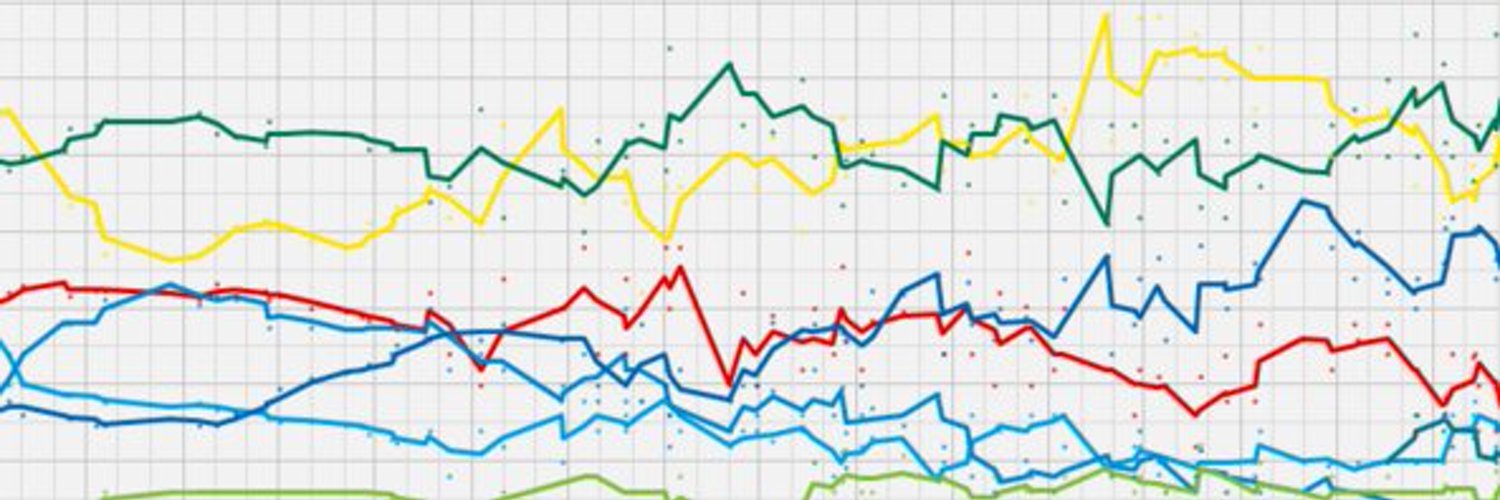
Generic Ballot: Democratic Advantage Erodes Sharply
The week's most significant development was a dramatic compression in the generic congressional ballot. Democrats opened the week with a commanding 6-point advantage in the Economist/YouGov survey (45%-39%), but two surveys released Thursday showed the margin had collapsed to 1-3 points. A Cygnal survey found Democrats leading 48%-45%, while RMG Research showed a near-tie at 47%-46%. The five-day shift from a 6-point Democratic lead to statistical parity represents substantial movement in early-cycle dynamics. The divergence between surveys—particularly the 2-point gap between Cygnal and RMG Research methodologies—underscores the volatility of national preference measures this far from the 2026 midterm election.
Whether this tightening reflects genuine erosion of Democratic support or represents normal methodological variance remains unclear. The compressed margins suggest Republican consolidation or movement among undecided voters, but the limited data set makes causal analysis premature. Tracking generic ballot movement over the next two weeks will clarify whether the trend continues or stabilizes. The relationship between national preference and district-level performance will prove critical—individual races may diverge substantially from the overall party preference metric as candidate-specific factors and spending emerge.
Michigan Senate: Rogers Establishes Early Lead
Mike Rogers (R MI-SEN) leads Abdel El-Sayed (D MI-SEN) by 6 points in the Detroit News/WDIV-TV survey of 600 likely voters, with Rogers at 48% and El-Sayed at 42%. The sample size is modest for a statewide survey, and the absence of competing public polling limits ability to assess whether the lead reflects structural advantage or survey variance. Michigan has demonstrated competitive dynamics in recent cycles, and the substantial undecided population suggests movement is possible as the race develops.
North Carolina Senate: Cooper Opens with Five-Point Lead
Roy Cooper (D NC-SEN) holds a 5-point advantage over Chuck Whatley (R NC-SEN) in the Carolina Forward/Change Research survey of 1,105 likely voters (47%-42%), marking the first public polling in the race. The 11-point undecided total provides significant room for movement. Cooper's initial positioning reflects his profile as an incumbent statewide officeholder, but confirmation from additional polling firms will be necessary to determine whether the margin reflects underlying Democratic strength in the state or represents normal early-cycle survey variance. North Carolina's recent trajectory toward competitive status in statewide contests suggests the race will tighten as the cycle progresses and candidate spending increases.
The combination of Rogers's 6-point lead in Michigan and Cooper's 5-point lead in North Carolina presents a mixed picture for the 2026 Senate landscape. Both represent incumbent or higher-profile candidates operating in competitive states, yet they diverge in partisan direction and magnitude. The limited data across competitive seats at this stage prevents broader conclusions about Senate control dynamics, but these races will serve as bellwethers for metropolitan versus rural turnout patterns as the cycle develops.
Week in Summary
The week revealed substantial flux in national preferences alongside early consolidation in individual races. The generic ballot compression from 6 points to 1-3 points may indicate shifting voter sentiment or methodological artifacts, but the pattern warrants close monitoring. Early Senate polling in competitive states shows incumbent-backed Democratic candidates leading, though sample sizes remain small and undecided populations substantial. The next two weeks of polling will establish whether the generic ballot stabilizes and whether the Senate leads represent structural advantages or typical early-cycle variance.
```Polls
Generic Ballot: Democratic Edge Persists Across Surveys
Recent generic ballot polling shows Democrats maintaining a consistent advantage heading into 2026. Across ten surveys conducted between late December and early January, Democrats averaged 45.8 percent support while Republicans averaged 41.9 percent. The spread ranges from 1 to 6 percentage points, with Cygnal's 3-point lead and RMG Research's 1-point advantage on the narrower end, while Big Data Poll's 5-point margin sits at the wider extreme. The consistency of Democrats holding polling leads across different methodologies and sample sizes suggests structural rather than idiosyncratic movement.
North Carolina Senate: Cooper Leads Early
Roy Cooper (D NC-SEN) holds a 5-point lead over Chuck Whatley (R NC-SEN) in a Carolina Forward/Change Research survey from January 7, with the Democrat at 47 percent and the Republican at 42 percent. This represents an early reading in what is expected to be a competitive race. The sample size of 1,105 respondents provides a margin of error of approximately 3 percentage points.
Michigan Senate: Rogers Leads El-Sayed
Mike Rogers (R MI-SEN) leads Abdel El-Sayed (D MI-SEN) by 6 points in a Detroit News/WDIV-TV poll from January 6, with Rogers at 48 percent and El-Sayed at 42 percent. The smaller sample of 600 respondents carries greater uncertainty.
Follow the Money
```htmlOhio Senate: Brown's Strong Cash Position
Sherrod Brown (D OH-SEN) leads the early filers with 26.0 million in total receipts and 17.0 million in cash on hand. Brown has spent 9.0 million so far this quarter, maintaining a substantial financial advantage at this early reporting stage. The Ohio Senate race represents one of the most competitive battlegrounds this cycle, and Brown's early fundraising pace signals robust donor engagement.
Michigan Senate: Multiple Democratic Candidates Report Spending Pace
Three Democratic Senate candidates from Michigan filed early reports, each showing distinct spending strategies. Haley Stevens (D MI-SEN) has spent the most aggressively at 5.5 million against 8.9 million raised, leaving 3.4 million on hand. Mallory McmMorrow (D MI-SEN) reported 8.6 million in receipts with 3.7 million cash on hand after 4.9 million in disbursements. Abdul El-Sayed (D MI-SEN) raised 7.6 million and spent 5.1 million, retaining 2.5 million. Michael Rogers (R MI-SEN) has raised 7.6 million with 4.2 million cash on hand and 3.7 million spent, positioning himself with more reserves than his Democratic opponents in the state.
Texas Senate and House: Candidates Running Low on Reserves
Colin Allred (D TX-SEN) reported concerning cash metrics across two filings, with combined totals showing approximately 11,951 dollars remaining after spending 7.8 million against 7.6 million raised. Jasmine Crockett (D TX-13) shows zero cash on hand after raising 7.9 million and spending 9.4 million, indicating her spending exceeded receipts in this filing period. Shawn Harris (D GA-02) similarly reports minimal reserves at 74,021 dollars after 7.8 million spent against 7.9 million raised. These low cash positions early in the cycle constrain candidates' ability to respond to unexpected developments or capitalize on late-cycle opportunities.
```Headlines
Visit pollingsource.com for the latest political news.
What to Watch
```htmlHouse Races in Swing Districts
Four House races rated as toss-ups by Cook Political Report warrant close monitoring: AZ-01 and AZ-06 in Arizona, and CA-13 and CA-22 in California. These districts will likely determine which party controls the chamber's narrow margins. Watch for polling shifts in these regions and fundraising disparities, which often signal candidate momentum or resource allocation by national committees.
Senate Races Shaping Majority Control
Georgia's Senate race (D GA-SEN) is rated lean Democratic by Cook Political Report, while Florida's Senate race (R FL-SEN) leans likely Republican according to Sabato's Crystal Ball. Movement in Georgia will be critical—any shift toward Republicans could strengthen their path to Senate control. Monitor early voting patterns and campaign spending intensity in both states as indicators of ground operation strength.
Lean Republican Opportunities
Five races rated lean Republican merit attention: CA-45 and CA-47 on the West Coast, plus CO-08, IA-01 (likely Republican), and others. These seats represent Republican pickup opportunities or Democratic hold scenarios depending on local conditions and candidate recruitment success.
```How was today's briefing?
Get this briefing in your inbox every morning
Free. No password required. Unsubscribe anytime.